Social media


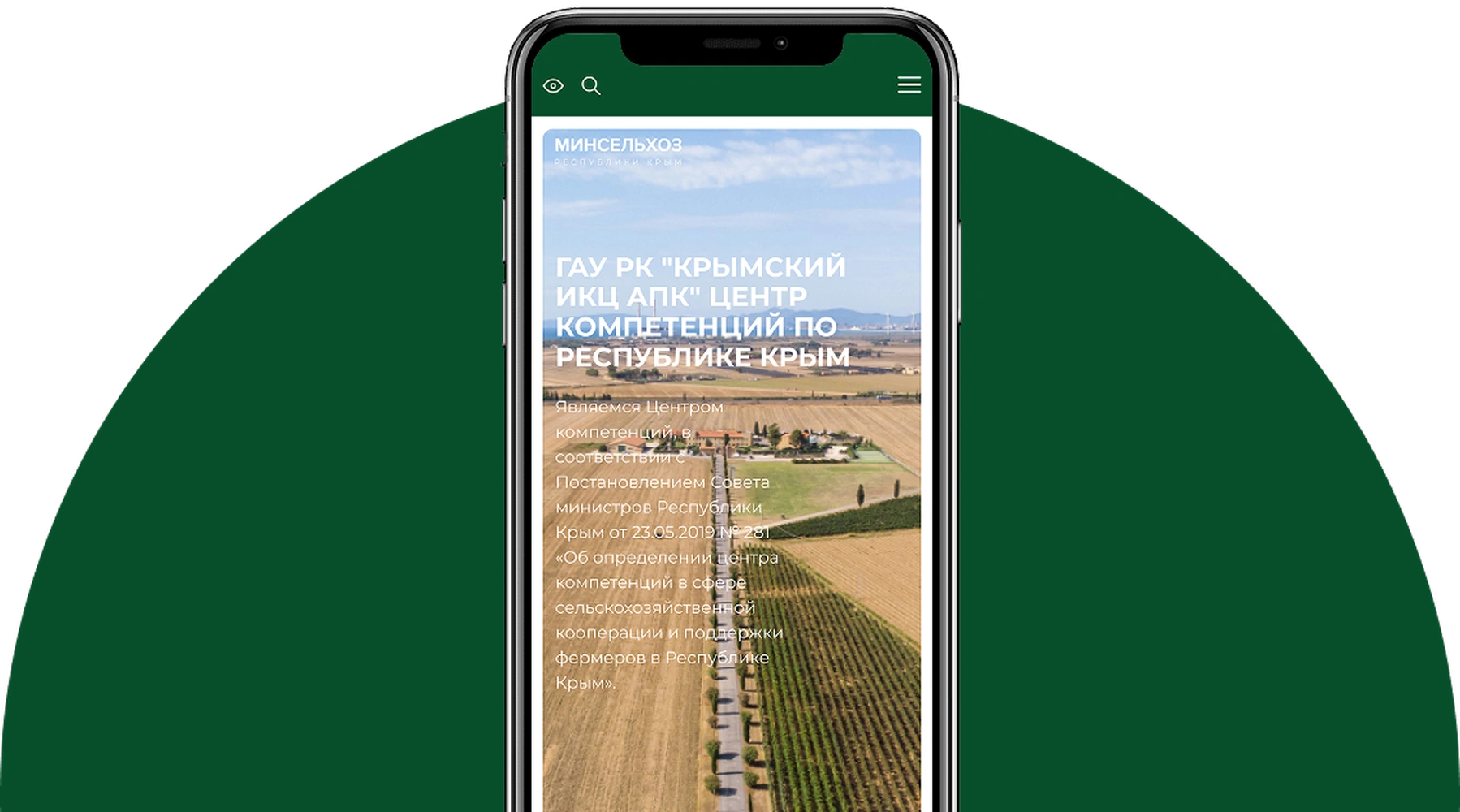
Under a government contract, CSG developed a new website for the Crimean Information and Advisory Centre for the Agro-Industrial Complex.
The Crimean Centre acts as a competence centre for agricultural cooperation and farmer support. Its website brings together institutional activities, services, government support, legislation, industry resources, news, events and education.
Designed as a comprehensive digital information platform, the project contains numerous sections and content types. The main challenge was a clear architecture that lets users find information quickly, regardless of the volume or complexity of the source material.
CSG was tasked with designing and developing a modern official institutional website capable of systematically handling extensive industry and reference information.

We designed the UX/UI from scratch around real user interactions with a public-sector information resource.
We designed the homepage, centre overview, activity areas, services, news, events, documents, government support resources, information pages and other content types.
Each entity received its own presentation logic: cards, lists, information blocks, publication pages, forms and navigation components.
We paid particular attention to mobile, adapting the interface so even lengthy materials and complex section structures remain convenient on a smartphone.
The visual system reflects the project's official character without repeating the typical aesthetic of government websites.
A restrained green-and-white palette, large typography, open compositions and a modular content system form the interface. Visual accents distinguish activity areas, guide users through extensive information and create a clear hierarchy.
A shared component system provides one visual language across very different page types, from news and events to regulations and support information.


The frontend uses Vue.js, enabling a flexible component-based interface and a user experience independent of the usual constraints of ready-made templates.
WordPress manages the content, while the user interface is a separate modern frontend system.
This combines convenient content administration for the institution's staff with bespoke UX/UI and custom frontend logic.
 FIGMA
 WordPress
 Vue.js
The architecture combines Vue.js and WordPress: WordPress serves as the content management system, with the frontend built in Vue.js.
This removes reliance on the CMS's standard template interface and enables a bespoke frontend with its own component system, responsive logic and visual language.
The administration interface remains convenient for regular updates to news, events, documents, industry materials and other sections.


